
Homeweb scripts are available on the Mason Cluster to help you set up your personal website and its permissions on mason.gmu.edu. Two scripts are available: homewebon and homeweboff.
homewebon
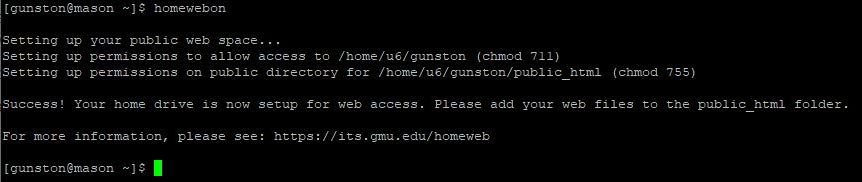
The homewebon script sets permissions on your home directory and creates a public_html folder with the permissions needed to publish web content. The script:
- Sets permissions on your home directory to
711. You, as the owner, can read, write, and execute. The group and others cannot read or write, but they can execute. - Checks whether a
public_htmlfolder already exists. If the folder does not exist, the script creates it. - Sets permissions on your
public_htmlfolder to755. You, as the owner, can read, write, and execute. The group and others can read and execute but cannot write.
These permissions allow the Mason web server to serve files from your public_html folder.
Step 1: Connect to the Mason VPN
Step 2: Connect to the Mason Cluster
Connect to the Mason Cluster using the instructions for your operating system:
Step 3: Run homewebon
At the command prompt, enter homewebon and press Enter.
homeweboff
Use the homeweboff script to remove your personal website from public view. The script changes directory permissions so the website files are no longer publicly accessible. Your content may still be cached or archived elsewhere on the web.
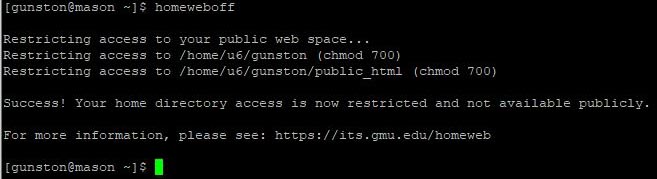
The homeweboff script:
- Sets permissions on your home directory to
700. You, as the owner, can read, write, and execute. The group and others cannot read, write, or execute. - Sets permissions on your
public_htmlfolder to700.
Step 1: Connect to the Mason VPN
Step 2: Connect to the Mason Cluster
Connect to the Mason Cluster using the instructions for your operating system:
Step 3: Run homeweboff
At the command prompt, enter homeweboff and press Enter.
This does not delete your web files. It changes the directory permissions so the files are no longer publicly accessible.
Step 4: Confirm the Website Is No Longer Public
Try to visit your personal website in a web browser to confirm that it is no longer publicly accessible.
Note: You may need to use a different browser or clear your browser cache before checking the website again.